Sunday, June 2, 2019

Blood, Sweat & Beers: What Three Tasters Agree On

Three tasters who like each other will usually agree on which beer of the night is best and rarely agree on what the number means, and the second half of that sentence is the part worth keeping. An archived tasting night in this blog's own records had three British Columbia beers in it, and Kyle, Matt and Mike each scored them out of five. All three ranked the flight in the same order, from the Vancouver Island imperial red at 3.2 up to a Surrey imperial pale ale at 4.4 or 4.5. That ranking is the least interesting thing in the entry. The notes underneath the scores, and what has happened to two of the three breweries since, are the reason to reread the night.

What The Panel Recorded

The entry lists three opinions rather than declaring a winner, which is the honest way to publish a group tasting. Nobody weighted the scores, nobody dropped the low mark as an outlier, and the same three people worked through all four beers in the same order on the same night. That leaves the gap between tasters visible, and on every beer the gap is small enough that the result never came down to one dissenting glass.

BeerKyleMattMikeGap between tasters
Thirty Years Imperial Red Ale, Vancouver Island Brewing3.23.03.20.2
Sap Sucker Maple Porter, Fernie Brewing3.94.23.70.5
Red Racer Imperial India Pale Ale, Central City4.54.44.40.1
Bootlegger Ale, brewery not recorded3.23.33.40.2

Thirty Years Imperial Red Ale, Vancouver Island Brewing

A brown long-neck glass bottle standing on a dark wooden table against an off-white wall, its dark label reading Thirty Years in cream script over the words Imperial Red Ale with a small round emblem below, and the bottle's shadow thrown to the right

The panel had built the evening around this one and came away mildly disappointed, which is what a 3.2 from three friendly tasters usually means. The note describes a beer caught between sweetness and hops, with what reads like molasses doing the bridging, and the verdict was that the addition changed the flavour without improving it. Kyle's line, a solid start and a syrupy finish, is the whole review. Vancouver Island Brewing made it in Victoria and sold it as a bigger, well-hopped relative of the pale ale that had been the brewery's staple for years.

Two things have moved since. The Government Street brewhouse closed on 1 November 2024 after a 35 per cent rent increase, and production moved across to Phillips Brewing, so the Victoria address in the notes is a place with a history rather than a working plant. The vibrewery.com address the notes link has been superseded by vibrewing.com, where the company now publishes.

Sap Sucker Maple Porter, Fernie Brewing Co

A brown long-neck glass bottle standing on a dark wooden surface against an off-white wall, with a red band label carrying the Fernie Brewing logo and the words Maple Porter above a pale grey panel reading Sap Sucker Maple Porter over a botanical illustration

This was the beer nobody expected to enjoy, poured for a panel that rarely reaches for a porter, and it drew the widest spread of the night at 3.7 to 4.2. The notes record a dark glass, gentle carbonation, and caramel and coffee running through it with the maple sitting behind the roast rather than on top of it. Matt's verdict, that a hint of maple makes it a genuinely Canadian beer and a good thing to pour over pancakes in the morning, is not something you can argue with. Two things to have straight if the name comes up: Fernie Brewing is in Fernie, in the East Kootenays, and Sap Sucker has been retired and is no longer brewed, so the seasonal the panel waited for is an archive item now.

Red Racer Imperial India Pale Ale, Central City

A brown long-neck glass bottle standing on a dark wooden surface against an off-white wall, with a neck band and main label reading Red Racer in red script above an illustration of a cyclist in white riding a red bicycle and the words Imperial India Pale Ale beneath

The top marks of the night, 4.4 and 4.5, went to a beer the panel admitted it had not expected from Surrey. The note is enthusiastic rather than careful: sweet malt and hops arriving together, and a finish long enough that all three tasters called it the best beer they had scored to that point. The brewery's own blurb promised grapefruit, tangerine and mango from whole-leaf hops and a long maturation before release. Mike's summary, smell check, taste check, alcohol check, it has it all, is not analysis, but it is honest about what a first great experience feels like.

Central City Brewers & Distillers has since gone through a change larger than a rebrand. The company ended up in a court-ordered sale, and Mark Anthony Group completed the purchase in February 2025. The Surrey plant that made the beer now sells it under the Homefield name, listed at Red Racer at Homefield Brewery, so the beer outlived the company name that made it.

The Beer Nobody Wrote Anything About

The panel scored a fourth beer, Bootlegger Ale, and filed three marks between 3.2 and 3.4 with no tasting note and no brewery recorded against it. That row is the most useful line in the whole table, because it shows what a score looks like when it carries no information. Nobody reading it later can tell whether the beer was fine, forgettable or flawed, and the closeness of the three marks only proves that three people agreed about something none of them bothered to describe.

What A Panel Score Can Tell You

Three people in one room produce an order you can trust more than the numbers on it, because that order survived a scale everybody uses badly. The absolute marks are another matter. The same beer can move half a point for the same drinker depending on the glass, the temperature and the position it was poured in, and a 3.2 in a flight where the top beer reached 4.5 mostly means third of three rather than a bad beer. Read a panel score for the ranking and the reasons attached to it, then let the decimal go.

What Happened When Everybody Became A Rater

A screen capture of two social check-in entries on a white background, the first reading that Mike W. is drinking a Witicism by Four Winds Brewing at The Nut House with four of five stars, the second reading that Adam is drinking a Pale Ale by Four Winds Brewing with three and a half stars, each with a small bottle thumbnail and a link to view the detailed check-in

Untappd does the same job at a scale no panel can reach. You log what you are drinking, rate it out of five in half-point steps, and leave the entry where your friends can see it. The difference is not that strangers are careless, since most of them are not, but that a crowd averages out everything a panel shares. Three tasters in one room had the same bottles at the same temperature with the same expectations going in, while a large set of check-ins mixes warm glasses, a dirty line, a long flight and two different production runs of the same label. A high crowd score is a weak argument that a beer is good. A crowd score that collapses against its own style is a decent argument that something is wrong with the can you are about to buy.

How To Run A Better Panel Night

  • Put the bottles in paper bags or pour identical samples into unmarked glasses, since a label changes a score before the first sip arrives.
  • Let everybody write a number before anybody talks, because the first confident opinion in the room quietly sets the range for the rest of the night.
  • Score each beer against its own style rather than against the last glass, which is how a very good porter loses to an imperial IPA on the same table.
  • Write one sentence with every score, because a number without a reason is the row nobody can use later.
  • Include one beer nobody in the group would order, which is where panel nights produce surprises more often than a flight of favourites does.
  • Keep the scale simple at half a point a time and stop arguing about whether a 4.2 is really a 4.

Frequently Asked Questions

Is a five-point or a hundred-point scale better for scoring beer?

Five points in half-point steps is enough for three people in a living room, because it forces a decision without pretending to a precision nobody has. A hundred-point scale lets two tasters disagree by four points about the same glass and both be reasonable, which makes the average meaningless. The extra resolution only earns its keep when one person scores the same style repeatedly over a long stretch.

Does agreement between tasters prove the score is right?

Agreement says the panel is stable, not that the number is true, and this flight is the example. Three people who tasted together, in the same room, from the same bottles, landed within half a point on every beer, which is what it looks like when tasters influence each other and share reference points. Consistency is a property of the group rather than a measurement of the beer.

Should a brewery care about a low panel score?

It should care about the sentence attached to it. A 3.2 gives a maker nothing to work with, while a note saying the added sweetener left the finish heavy points at an exact decision in the recipe, and that is the kind of feedback a drinker rarely puts on a public rating feed.

Order, Reason, Then Ignore The Decimal

If you want to keep the useful part of a panel night, publish the ranking and the reasons and let the averages go. Two of the three breweries in this flight have changed out of recognition since the glasses were filled, one of the beers is no longer made, and the only thing in the record that still holds up is what three people said the beers tasted like. That is worth more than a decimal, and it is the part that outlives the brewery.

Friday, May 17, 2019

Beerin' Ain't Easy: Four Picks and the Winter Ale That Flopped

Four bottles went on the table at the Council's fourth meeting, and the honest summary is that three of them were good beer and one was a disappointment the group refused to inflate. Dageraad's Randonneur Saison from Burnaby took 3.9 out of 5, Parallel 49's Snap, Crackle, Hop from Vancouver took 3.8, Steamworks Wheat Ale took 3.3, and Pray for Snow, a winter ale from Oregon, finished at 2.7, which the notes called a generous number at the time and nobody raised afterwards. Choosing four bottles that four people will disagree about is the easy half of a night like this. Writing the disagreement down is the part that is not easy.

The rules were the ones the group has kept since the first meeting. Each member brings one beer, everybody tastes before anybody argues, and a score goes on the sheet once and cannot be revised afterwards. There were four tasters that evening, which is why the columns below are worth as much reading as the averages: the wheat ale ran from 4.0 at one end of the table to 2.8 at the other, while the four numbers on the saison sat inside a single point of each other.

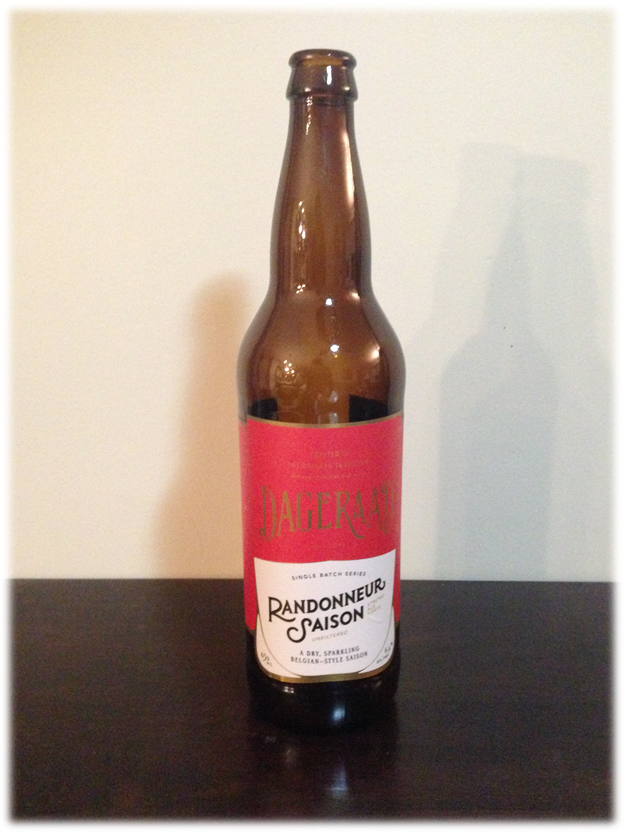
A brown glass bottle with a crimson Dageraad label and a white band beneath it reading Single Batch Series, Randonneur Saison, unfiltered, a dry sparkling Belgian-style saison, standing on a dark table against a pale wall

Randonneur Saison, Dageraad Brewing, Burnaby

Kyle's pick was the second release in Dageraad's Single Batch Series: unfiltered, bottle conditioned, and labelled in one line as a dry, sparkling Belgian-style saison. The brewery's suggestion at the time was seafood or salad, and the table agreed on the seafood half. Peppery, hoppy and bone dry, with enough carbonation behind it to make the finish feel like something out of a soda fountain, it was the best beer of the night and still finished with a 3.9 average, much to the chagrin of the man who brought it. Kyle's own line was that it may not be the season for saison, but it was incredible, and his 4.3 was the second highest number anybody wrote down that evening.

One style note belongs beside this bottle, because the sheet got it backwards and a BC reader will notice. A gose is not a Belgian farmhouse ale. It is a German wheat beer, soured in the kettle and usually seasoned with salt and coriander, and the Belgian farmhouse beer in that comparison is the saison itself, exactly as Dageraad prints it on the label. The mix-up is a forgivable one from a table, since both beers are pale, dry and heavily carbonated, but the sourness in a gose comes from bacteria while the pepper in a saison comes from the yeast, and that difference is the whole reason the two taste nothing alike.

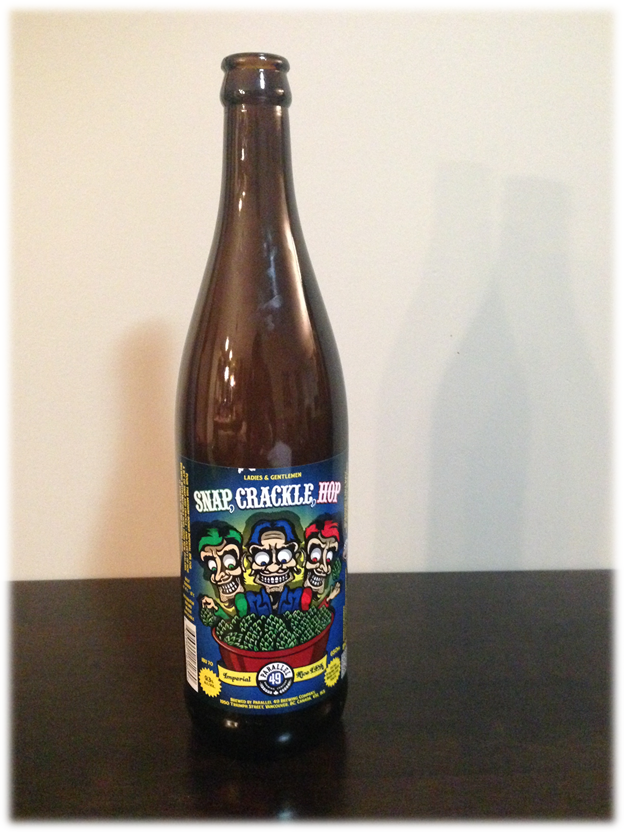
A tall brown glass bottle of Parallel 49 Snap, Crackle, Hop, the blue label showing three grinning cartoon heads leaning over a red bowl of green hops, with 9.3% printed on the lower band

Snap, Crackle, Hop, Parallel 49 Brewing, Vancouver

Matt's pick was an imperial IPA brewed with flaked rice to keep the body light and push the New Zealand Motueka hops out in front, and the brewery put the alcohol at 9.3 percent, which the label repeats on the band under the three cartoon heads. Peach and mango arrived first, then a caramel layer and a hop bite that stayed put, and the rice did what the brewery said it would by adding dryness rather than a new flavour. The group's own warning was that a few of these will make the walk home difficult, written down by people who fully intended to ignore it. The average came to 3.8, with Matt's 4.4 the highest score he had given any beer to that point and nobody else getting above 3.8.

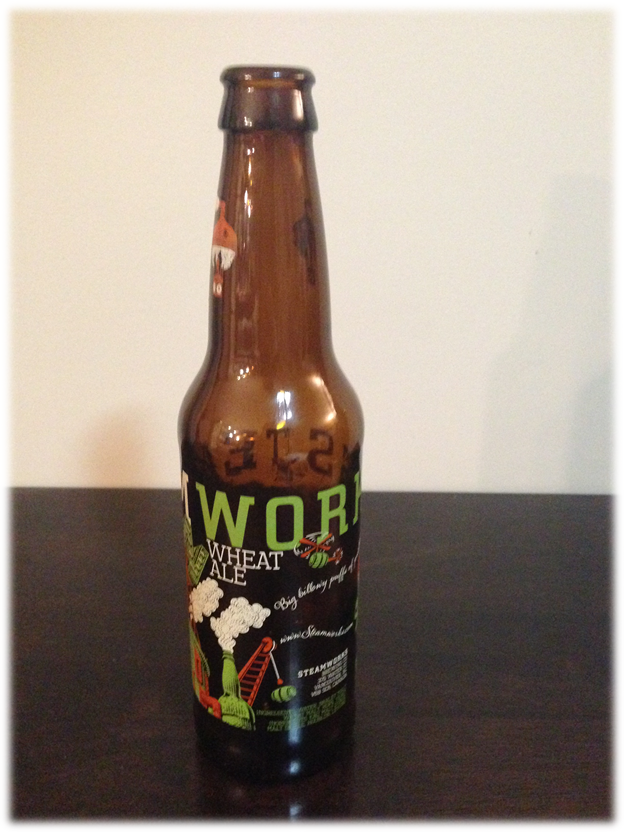
A brown glass bottle with a dark Steamworks label reading Wheat Ale in white beneath green lettering, above an illustration of factory chimneys puffing white smoke beside a red ladder and green hop cones

Wheat Ale, Steamworks Brewing, Burnaby

Mike brought the bottle that started the argument, and the argument was with the front label. He had been through the brewery more than once, so he knew what he was buying and the rest of the table did not. The beer is called Wheat Ale, and Steamworks' own description of it says South German style hefeweizen, which is the same thing said more precisely: hazy gold, thick white head, banana, clove and a hint of bubblegum. The group found the banana, the yeast and a spice edge, agreed it was a decent beer, and then disagreed about everything else. It finished at 3.3 with the widest spread of the night, Kyle at 4.0 and Tim at 2.8, which is what happens when four people taste for the beer they each wanted. Mike's own verdict was that Steamworks turns his crank, printed beside his own 3.3. The brewery grew out of a Gastown pub and has run its brewhouse in Burnaby since 2013, so the city on this sheet is years out of date.

A brown glass bottle with a plain white 10 Barrel label printing Winter Ale and Pray for Snow in black block letters above a sketch of a can marked with the number 10

Pray for Snow Winter Ale, 10 Barrel Brewing, Oregon

Tim picked a winter seasonal at 7 percent and the table could not rescue it. The pour was dark amber browning at the edges and looked full-bodied before it hit the tongue, and the sweetness arrived as syrup rather than caramel, with a heavy finish that most of the room expected to pay for the next morning. The average was 2.7, described in the notes as generous, and Tim's line was that if this is what winter has to offer then he is not praying for snow. Whether the beer still exists anywhere is a fair question and not one a sheet from 2014 can answer.

Two facts belong beside that score. The brewery is from Bend rather than Portland, and it was sold to Anheuser-Busch InBev in October 2014, the autumn this bottle was poured, which is the kind of change that turns a craft recommendation into a different product wearing the same name. All About Beer reported it at the time.

The Scores From That Night

Four tasters, four beers, one sitting, and no revisions after the fact. The averages are the ones quoted above, and the columns are where the night actually lives.

BeerKyleTimMikeMattAverage
Randonneur Saison, Dageraad4.34.23.63.43.9
Snap, Crackle, Hop, Parallel 493.63.83.44.43.8
Wheat Ale, Steamworks4.02.83.32.93.3
Pray for Snow, 10 Barrel2.72.32.13.02.7

Where These Breweries Stand

Dageraad is still brewing in Burnaby, which makes the saison the one bottle here that a reader can still go and find from the brewery that made it, if the Single Batch Series has moved on since. Parallel 49 was last confirmed operating in Vancouver in 2025. Steamworks still runs the Burnaby brewhouse that grew out of its Gastown pub. 10 Barrel has changed hands, and a winter seasonal from 2014 is not a shopping tip. The Council ran the same format again at its New Year meeting, written up as the New Year tasting, where a golden ale brewed with pears took 4.3 and a strong Belgian-style tripel split one taster from three.

Why The Low Score Is The Useful One

The 3.9 and the 3.8 will age well, because in both cases the brewery said plainly what the beer was and the table found it. The 2.7 is the entry worth keeping. A group that had already handed out three respectable numbers that evening could have written a kind line about an Oregon winter ale and nobody would have blinked, and instead they printed the number they meant and labelled it generous in the same breath. If you keep a tasting sheet with friends, copy that habit rather than the scores: write one line per beer before the conversation starts, keep the spread visible next to the average, and leave the low numbers in place, because a low number is the only part of the sheet that tells a reader something the writer did not already have to believe.

Thursday, May 2, 2019

Nothing to Be Embeerrassed About: Four Bottles From the Council's Third Week

Four bottles went on the table in the third week the Council sat down to score its own picks, and nobody had much reason to go home embarrassed. Three came from BC breweries and the fourth came from a homebrewer in Langley who had never sold a drop of it. Angry Scotch Ale from Russell Brewing in Surrey finished at 3.5 out of 5, Hoyne's Big Bock from Victoria took 4, Longwood's The One That Got Away from Nanaimo took 3.7, and the pumpkin porter went onto the sheet as a bonus pour with dashes in every column instead of numbers. A 3.5 from three drinkers who bought their own beer is not an insult, and that is the promise in the title.

The method has not moved since the first write-up. Each member brings a bottle, everybody tastes before anybody talks, and a number goes on the sheet once and cannot be revised afterwards, which is why the spread inside one beer is worth more reading than the average printed beside it. This week that spread was narrow on all three scored bottles, and the highest mark the group had handed out to that point went to a beer it did not think was much like a bock.

A 650 mL brown glass bottle of Russell Brewing Angry Scotch Ale, its orange and black label showing two crossed swords beneath a white lion and unicorn and a moose crest on the neck, standing on a dark table against a pale wall

Angry Scotch Ale, Russell Brewing, Surrey

Russell bottled this strong Scotch ale in a 650 mL brown glass bottle at 6.6 percent and sold it in the language of the old Scottish shilling grades, promising a long boil and dark fruit and toffee from the roasted malt. The Council found the toffee and very little of the intensity the name is reaching for. It was smooth enough that a second bottle sounded pleasant rather than heroic, which is the one thing a Scotch ale rarely manages. Kyle's line was that it was smooth, drinkable and enjoyable, but only got the silver medal from him, and Tim and Tyrone landed at 3.5 and 3.2.

The bottle did better with outside judges than it did at this table. The official 2010 World Beer Cup results list it under the brewery's fuller name, Russell Wee Angry Scotch Ale, taking bronze in the Scottish-Style Ale category against 29 entries. That is a useful thing to know about a score of 3.5, because it means the beer was not flawed and not bad, only not what three people at that table wanted that night.

A brown glass bottle wearing a dark blue label with a strutting rooster and the name Big Bock in orange block letters, and a 650 mL band at the base, standing on a dark table against a pale wall

Big Bock, Hoyne Brewing, Victoria

This was the second Hoyne bottle at the table and the one that produced the best number on the sheet: 4 out of 5, with Kyle and Tyrone both at 4.0 and Tim a tenth of a point behind. The pour was a deep red amber with sweet malt and floral hops carrying from the first nose through to a clean, earthy finish, plus a light fruit layer nobody had expected. The tasters were clear that it was nothing like a traditional bock and equally clear that they did not mind. The rooster on the label is a leftover from a longer name, since the brewery first called the beer Big Cock Bock and the BC Liquor Distribution Board rejected it, and Big Bock is what came after.

The label copy still leans into the bird, in a passage about a majestic rooster unafraid to strut his colours and proclaim his dominion while the flock pretends not to listen. Tyrone's complaint was the practical one, which was that a beer this good asks you to go looking for it, and putting in the effort is not something a tasting group should have to do on a weeknight.

A brown glass bottle with a pale blue Longwood Brewpub label reading Red Wheat Ale in a green banner above an illustration of a hooked fish and the name The One That Got Away in white

The One That Got Away, Longwood Brewpub, Nanaimo

Longwood built this red wheat ale around a West Coast tuna fishing derby out of Bamfield, put half the grain bill into wheat, added a generous dose of crystal malt, and told people to drink it with seafood. The label in the photograph makes the same argument with a hooked fish. The Council got a slight red hue, a subtle sourness, a bitter edge that a note of banana kept from getting aggressive, and a head that did not turn up to the party. Tim's verdict was that it was full of colour, a little yeasty, ever so sweet and not worth mourning, and the 3.7 average put it in the middle of the three.

The Bonus Pour: A Homebrew From Langley

The fourth bottle did not come from a brewery at all. Greg Clark of Langley had brewed a chocolate pumpkin porter called Jack-o-Heed and brought it to the meeting, and the group poured it as a bonus and entered dashes rather than scores, which is the right call when the only source of a beer is the man who made it. The body looked as thick as Guinness and went down far more smoothly than that description promises, with pumpkin running quietly underneath and a roasted chocolate finish that stayed put long after the glass was empty. It was the one bottle nobody at the table had a complaint about, and one unscored sample is not enough to make more of than that.

The Scores From That Week

Three tasters, four bottles, one sitting, and no revisions after the fact. The averages are the ones quoted above, and the columns are where the disagreement lives.

BeerKyleTimTyroneAverage
Big Bock, Hoyne4.03.94.04.0
The One That Got Away, Longwood3.63.73.83.7
Angry Scotch Ale, Russell3.93.53.23.5
Jack-o-Heed, homebrew---Not scored

Where These Breweries Stand

Two of the three names on this sheet are still pouring and one is not. Russell closed its Surrey brewery and tasting room in April 2026 and sold the equipment, and the company has since moved to contract brewing, so the address printed on the label is not a place you can visit any more. Surrey was also the closest of the three to where the group sat, and the write-up treated it as the promising start of a tasting map and floated the idea of a first brewing tour there. Hoyne is still brewing in Victoria and has opened a tasting room of its own in the years since. Longwood is still trading in Nanaimo. Whether any of these three beers is still in the lineup is a separate question, and one you can only answer from a current list rather than a sheet from 2014. The write-up of another early Council meeting covers four other bottles from the same run, plus a bonus gose that split the table two against two.

What A Middle Score Is For

A 3.5 is the hardest number to publish and the most useful one to read. A brewery can shrug off a bad night, and a panel that says 5 out of 5 has nothing left to tell you, but a 3.5 with the reasoning attached says something specific: the beer did what it claimed and did not do more than that. If you keep a sheet like this with friends, write one line before the number goes down, keep the same drinkers for a whole season so the scores mean something against each other, and leave the middling marks where they are. Three weeks in, this is what the record has become: what three people thought on a night in 2014 about beers from a Surrey brewery that is now gone, a Victoria brewery that is still pouring, and a Nanaimo brewpub that is still trading.